By Peter de Kuster
Introduction: Place Vendôme — Where Power and Rebellion Meet
Picture yourself in the heart of Paris, standing in Place Vendôme. Around you, the symmetrical elegance of classical architecture rises, their windows shining under the Parisian sun. The Vendôme Column, imposing and proud, stretches skyward—a towering monument constructed from the cannons of Napoleon’s defeated enemies, glorifying imperial victories and military might.
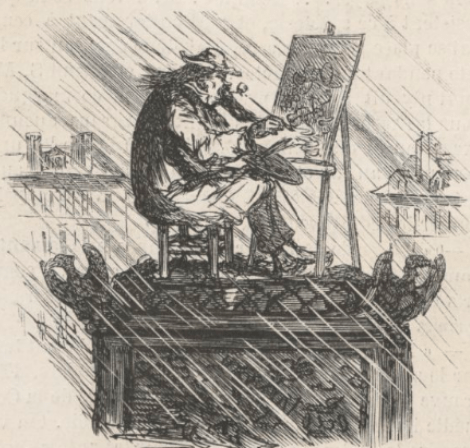
Yet, beneath this sanctuary of tradition and power burns a rebellious spirit—the spirit of Gustave Courbet. His story is as intertwined with this square as the stones beneath your feet. In 1871, amidst the ferocity of the Paris Commune, Courbet took a bold step: he called for the Vendôme Column’s destruction. To some, this was blasphemy; to him, it was a necessary act to dismantle false narratives and reclaim the truth.
At this moment, Courbet’s journey crossed from individual artistic struggle to collective historical impact. This location is not simply Place Vendôme—it is the threshold of transformation, where the story of a man and a city entwined forever.
Walking here, immersing yourself in the echoes of revolution and art, consider this: What parts of your story need dismantling? Where do you stand ready to rewrite history with your own truth?
Chapter 1: The Roots of Realism — Courbet’s Childhood in Ornans
Our journey begins far from the bustling city, in a quiet town nestled along the Loue River—Ornans, where Gustave Courbet was born on June 10, 1819. Imagine the young Courbet moving along riverbanks, wilderness, and farms, soaking in a world shaped by honest labor and natural grandeur.
Ornans was a place where the ordinary life of peasants and landscapes told their own stories, rich with texture and detail ignored by lofty art academies. The boy’s experiences here laid the foundation for his radical vision of art—not to escape reality but to embrace it fiercely and authentically.
Courbet’s early life was both ordinary and remarkable—a sure footing in humility and clarity before an adventure into the complexities of Parisian art and society.
This phase of his story invites reflection:
- What gifts or lessons from your origins shape your story unacknowledged?
- How does your past inform your unique path?
Chapter 2: Paris Beckons — Responding to the Call
In 1839, Courbet left the rural safety of Ornans and journeyed to Paris, a city exploding with cultural ferment and artistic tradition. The bright lights of the Louvre and the salons heralded possibility but also rigid expectations.
Courbet’s call to adventure was to free himself from artistic convention and social dictates. At the Louvre, he studied the masters with reverence but was restless—the polished idealisms of Neo-Classicism could not quench his desire to depict truth in raw form.
His studios filled with sketches of peasants, landscapes, and working men—his artistic voice beginning to roar.
Imagine this pivotal crossing—leaving behind familiarity and stepping into the urban tempest of ideals and challenges.
Pause and ask yourself:
- What calls to you, urging you beyond comfort to your true path?
- When did you first hear your own inner call to adventure?
Chapter 3: Confronting Tradition — The Salon and The Stone Breakers
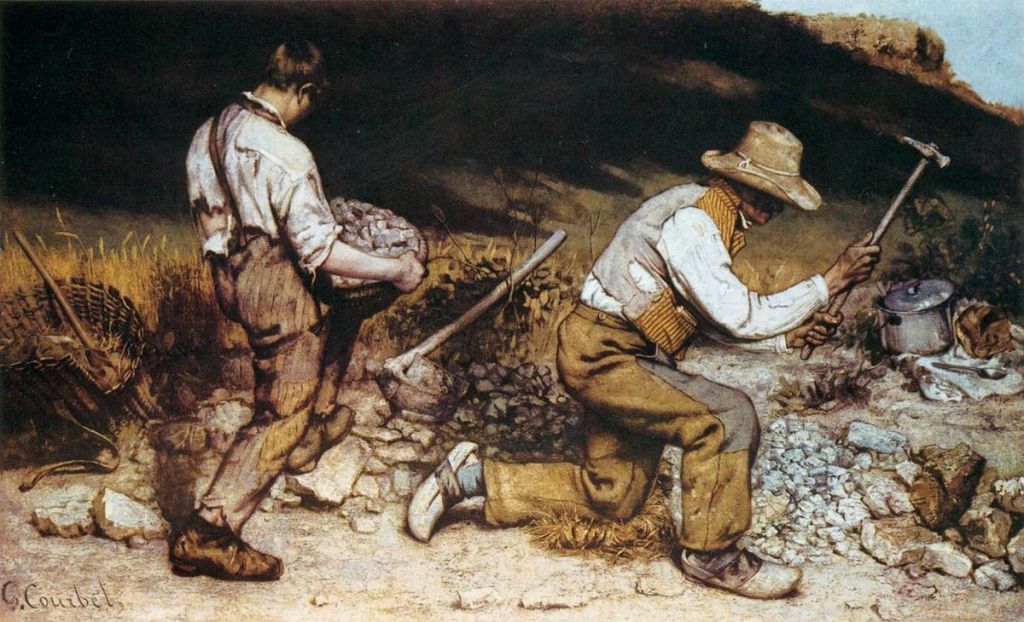
In the 1840s and early 1850s, Courbet forged his path through battle after battle with the establishment. His paintings The Stone Breakers (1849) and A Burial at Ornans (1849–50) shocked Paris. Large canvases featuring peasants and ordinary funerals were seen as vulgar and inappropriate for such scale.
Walking the streets of Paris then, the salons were the ultimate arbiter—the gatekeepers of tradition and power. Courbet’s work challenged their rules, his realism was both celebration and revolt.
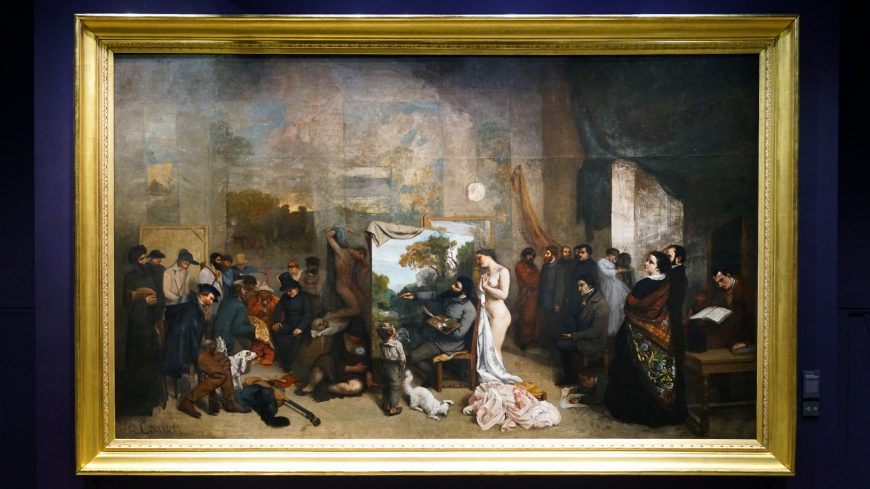
He faced rejection, scorn, and isolation—but also fierce commitment to his vision. His milestone moment came in 1855 when the official Salon refused to exhibit his massive The Painter’s Studio. He then organized an independent exhibition—his own pavilion of realism—declaring artistic freedom and autonomy.
As you walk the neighborhood near the Palais Royal, where the salons once were, imagine the artistic battles waged here, the arguments of visionaries and critics.
Ask yourself:
- Where have you faced rejection for your truth?
- How do you sustain conviction in the face of doubt?
Chapter 4: From Artist to Revolutionary — The Paris Commune
The 1870 Franco-Prussian War shattered France; the desperate social currents formed the Paris Commune in 1871. This revolutionary government briefly took control of the city. Courbet, deeply committed to social justice, was elected president of the Federation of Artists.
At this historical juncture, Courbet blended his artistic mission with political action. He fought to reopen museums closed during the war, democratize access to art, and dismantle elitist art institutions.
The symbolic act—the destruction of the Vendôme Column—was Courbet’s daring statement against militarism and imperial pomp.
Imagine the streets of Paris alive with hope and violence, the sound of crowds and cannon fire blending as art and revolution fused.
Reflect deeply:
- How does your personal mission intersect with greater social or cultural causes?
- What symbols or structures in your life or society need reevaluation or dismantling?
Chapter 5: The Cost of Truth — Imprisonment and Exile
The fall of the Commune brought consequences. Courbet was arrested, imprisoned, and fined a fortune for the column’s destruction. Imprisonment was six harrowing months; unable to pay, he fled to exile in Switzerland.
He spent his last years in La Tour-de-Peilz with his family, painting landscapes suffused with sorrow and reflection—his artistic voice muted but not silenced.
As you imagine this quiet lakeside refuge, consider the toll of your own sacrifices for truth and authenticity.
Reflect:
- What losses have shaped your story?
- How do you nurture creativity during challenging seasons?
Chapter 6: The Legacy — Resurrection and Enduring Influence
Though Courbet died in 1877 far from Paris, his legacy returned to the city and the world. His bravery created new pathways in art, inspiring Impressionists and modern movements.
Today, his works fill the Musée d’Orsay and numerous collections worldwide—a testament to a hero’s story transcending time.
Walking through the galleries, you see through Courbet’s eyes, a world unvarnished but profoundly human.
Ask yourself:
- How does your story inspire others?
- What will your legacy be?
Reflective Questions for the Traveler
As you traverse Courbet’s Paris and his life’s landscape, engage with these questions not just as an observer but as an author of your own story:
- What is the core truth your story must tell?
- When have you stood against conformity to live authentically?
- Where have you been ‘exiled’ emotionally or socially? How did you return?
- What are the monuments, literal or symbolic, you are called to dismantle or transform?
- Who are your allies and mentors on this journey?
- How does vulnerability open pathways to power in your story?
- What legacy are you cultivating with every step you take?
 The Hero's Journey in Paris